
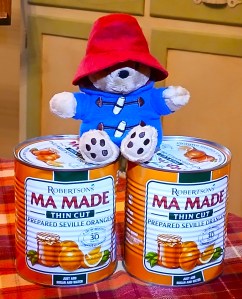
Last weekend, I finally popped ‘round to see my friends in western South Carolina, which we’ve talked about doing for a while. This time, Crystal stayed home for her teaching and to take care of Oliver the cat, who has to have his medicine twice a day. I say “popped ‘round,” a British expression, because the husband and father of this family is my good friend, the English author and speaker Joseph Pearce. I brought them two jars of my homemade English orange marmalade and a jar of English Marmite to spread on their morning toast. I used English-brand, canned, Seville oranges to make the marmalade. Among other things, we were able to have some wonderful meals and also to record three of his popular podcast and YouTube interviews together.
 Finally, it’s that time of year at the Hilltop! Hyacinths are springing up across the front! Many more bulbs about to bloom!
Work on my new Symphony No. 4: Scenes from an Enchanted Lake has been in progress for over three months! You may have heard bits of it here. Having first posted all of movement two on Dec. 19, subtitled “The Loon”, I have lately been working on movement one, “The Swan”. (Both birds hear music from the enchanted lake, inaudible to humans.) The music that has come to me for this movement is naturally in a swan-like mood – so far, being the themes that make the “exposition” of its Sonata form. That just means the main themes are introduced, or “exposed.”
Now I’m into the sonata’s “development” section, in which these themes are varied and explored in various keys. With the final “recapitulation” section, I’m roughly projecting the entire movement to come in at eighteen minutes and the entire four-movement symphony at around an hour, a bit longer than my third symphony. Having had scenes with the Loon and the Swan, I hope to feature the Phoenix and a flock of Wild Geese in the remaining two movements.
Here’s a short paragraph for music tech nerds; feel free to skip it: I just found out I can export my finished virtual audio mockups straight out of Sibelius with my great NotePerformer4 sounds, using my much better reverb plug-in, Valhalla Room, without first having to export the Sibelius audio files into my DAW. They have so improved the mix from Sibelius that I no longer need to use a DAW! I do have to make a “save as” copy of the file, one copy with dynamic marks that sound right for the mockup mix, and another copy with the acoustic dynamic marks that I’ll want the real human player to use. They are not always the same.
Here’s a paragraph for car nerds: I’ve been driving an old 2003 Lexus RX 300 SUV for several years, and the transmission is now in need of serious repair. The problem is, you can’t get parts that old to repair it. So the cheapest plan has been to get a working transmission out of an old junkyard car of the same model and vintage and swap them out. Too bad there isn’t one available in a junkyard! An after-market transmission is going to be $6,400. Installed – more than the car is worth in Blue Book. With engine work also needed, it could be as much as 10K to get that car in good condition, and so I have to weigh that against just buying another used car for that amount, which may also need repair (and who knows when). Will be sorting that out in the days ahead. If the SUV is all well, it might still be preferable to keep than to buy a cheap little tin-can car.

Two paragraphs for cooking nerds: I discovered and made a new recipe that we loved and will have again. Buy some sweet red, yellow, and orange peppers and cut them into chunks (remove any seeds), and add quarters of two large red onions, separated into “petals.” You can serve this dish with rice or potatoes. Toss the peppers and onions into a 9 X 13 casserole dish with a whole jar of Harissa sauce (it comes in a short jar in the condiment aisle) and a handful of chopped parsley or mint. Mix these all around with your bare hands and then your hands will be coated with the Harissa.
Rub that Harissa by hand all over a small, whole, raw spatchcocked chicken (about 3 lb.) and lay the flattened chicken across the top of the veg, sprinkle some salt and pepper on, and bake the whole dish at 350 F till done. It took about two hours for mine to get done, and it had a few lovely charred spots on the chicken. This will feed four. Even after the two of us finished eating the chicken over two meals, we still had lots of the veg remaining, and so we had it a third night with pieces of Polish sausage to replace the chicken, and that was just as good.
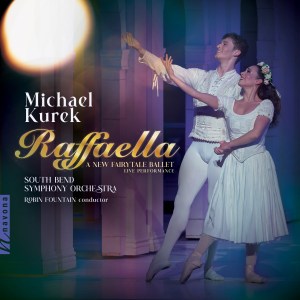
Since I last wrote, one of the most thoughtful reviews of my music ever (in this case, of my Raffaella ballet) was published HERE. So I’m happy to share it for anyone who wants to learn more about the ballet, which is here mentioned in connection with the March 7 (last Friday night) premiere of the YouTube video. It is still available on YouTube HERE. On the night of the ballet’s digital debut, over 540 users from across the globe logged onto their devices to watch it live. “Three days later,” they posted, “Raffaella had garnered more than 5,100 views and continued comments of earnest praise.”
By the way, an audio CD album of the ballet music has been mastered and in production but is waiting for a contractual green light from the orchestra to release on Parma / Navona Recordings. This may take a while to sort out, though. Shown above is what the cover art might look like.
Another review of the third symphony album appeared in the Canadian music magazine Textura as the featured article, with yours truly on the cover. You can read the review HERE. I’m happy with the closing sentence: “[Kurek] was taught by, among others, Hans Werner Henze and William Bolcom but has, as the evidence clearly shows, developed his own magnificent voice as a composer.”
I leave you with this wonderful tip I read and have tried, and it works: To keep a bunch of celery from going limp in the fridge, take it out of the plastic bag when you get home and wrap it in foil!



 Michael Kurek, Composer